Why shoplifters steal

Why shoplifters steal

It might be a crime, but chances are you know someone who has shoplifted at some point in their lives, with recent studies indicating one in 11 Americans shoplift.

In cold hard numbers, statistics indicate 27 million Americans are shoplifters, while 10 million have been caught in the act at some point in the past five years.

And it begs the question, why do people shoplift? What leads them to believe they have the right to take an item without paying for the privilege?

So as a retailer seeking to minimize loss, here’s an insight into the different types of shoplifters and why they choose to steal…

The types of shoplifters

Researchers commonly break shoplifters down into three distinct categories:

The professional – This shoplifter steals for economic gain as part of a group or individually. They might be a member of an organized retail crime or a solo operator, but their intention is to profit from the resale of their pilfered merchandise.

Often their crime is premeditated, and the perpetrator has an acute understanding of the worth of the products they steal. For the retailer, the professional is one of the hardest shoplifters to spot but usually targets popular consumer goods with a high resale value.

The amateur – This shoplifter steals for the “rush”, at the behest of friends or out of simple necessity. It’s not about economic gain, but about social status or even survival, and often includes teenagers who steal as a rite of passage.

In fact, according to the National Association for Shoplifting Prevention (NASP), around a quarter of all American shoplifters are teens, and chances are they’re stealing on a dare or out of boredom.

The opportunist – This type of shoplifter rarely enters a retail environment intending to steal, but rather takes items because security is lacking, or the opportunity is available. They may also steal out of retribution for a lack of service, or because they feel entitled to a discount due to their previous patronage.
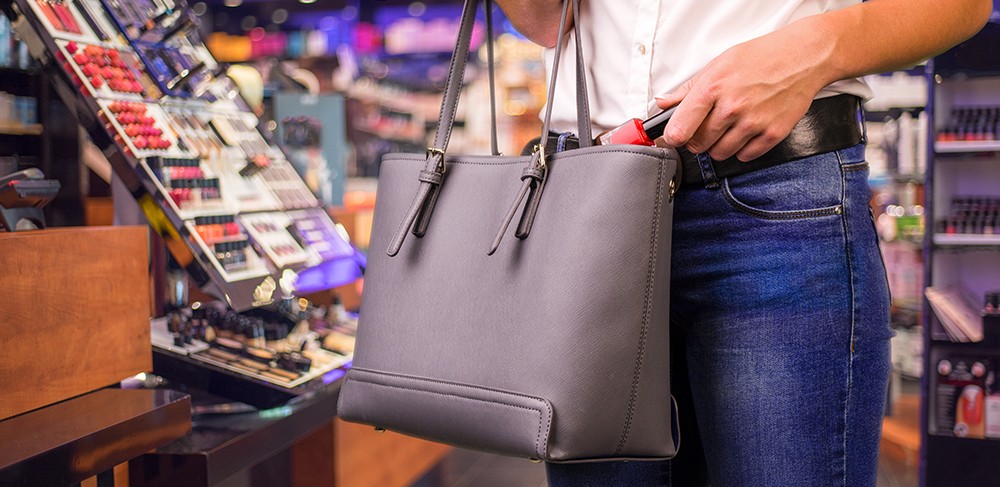
Why shoplifters steal

The reasons people steal

According to Australian research, while most people fall into the three categories of professional, amateur and opportunist, there are a variety of further reasons and justifications that compel people to steal, which are broadly broken down into rational and non-rational reasons.

Quite simply, rational thieves are motivated by profit or gain, while non-rational shoplifters may be prompted by psychological issues and stressors.

Within the rational and no-rational reasons people steal, there are also further factors that contribute to shoplifting:

Socio-economic disadvantage (impoverished) – The impoverished shoplifter steals out of need, but despite their disadvantaged socio-economic situation may still be hard to pick.

The drug user/addict – This shoplifter steals to feed a habit either re-selling the items they take or attempting to return them for a financial refund.

The thrill seeker – Usually egged on by a dare, the thrill seeker tends to steal on a whim and as part of a group. Teenagers fall into the amateur and thrill seeker category.

The kleptomaniac – This type of shoplifter generally targets low value items and steals out of compulsion.

The absent-minded – This unintentional shoplifter steals by pure mistake, and may include the elderly, and parents distracted by young children.

How to prevent shoplifting

Regardless of whether a shoplifter is stealing out of necessity, for economic advantage or because of opportunity, combatting retail shrink involves using multiple strategies and having a comprehensive approach to product security.

Loss prevention and shoplifting mitigation includes:

  • Educating staff about the behaviour of shoplifters and suspicious activity to watch out for.
  • Electronic article surveillance to monitor stock, including advanced security tags with increased magnetic strength like SuperLock, HyperLock and multi-polar tags.
  • Regular stock takes and inventory tracking to ascertain whether items are stolen and what stock is most at risk.
  • Good store layout to eliminate hidden areas, and to position high-value stock/commonly stolen items within view of staff.
  • Good customer service.
  • CCTV monitoring.
  • Tethered cables, lockable displays and cabinet locks.

Together, these strategies, along with understanding the behaviour of shoplifters, mitigate the risk of shoplifting, allowing the retailer to concentrate on the sales rather than the loss.

2019 a year of retail transition, predicts Deloitte

2019 a year of retail transition, predicts Deloitte

Deloitte has released its retail predictions for the year ahead, noting 2019 will be a year of transition for US retailers.

Following a bumper holiday season, they tip this year will again be driven by disruption and an increased consumer expectation, where retailers who clearly understand their position, potential and role in the market will be best poised to thrive.

Here’s an insight into the retail trends of 2019 and the top tips that retailers can embrace to strike a chord with an increasingly savvy consumer.

A year of transition

Deloitte explains 2018 offered a lot for US retailers to digest. The year featured trade and economic tensions, mixed retail figures, some high-profile bankruptcies, yet a record-breaking holiday season.

It also saw the consumer expectation further increase, as the digitally savvy shopper continues to embrace the idea of having it all – convenience, values that align with their own, information at their fingertips, and a more personalized retail experience.

“The next 12 to 18 months will likely see an industry in transition—an industry managing through uncertain times and placing bets on what will separate the winners from the losers. Those who can synchronize their investments to profitably empower the consumer will likely find themselves on the right side of the tipping point.”

Why do you matter?

In 2019, retailers will need to know why they matter more than ever before. In an increasingly competitive online and physical space, they will need to be “crystal clear” about their offering and position in the market.

What makes you unique? Why would the consumer pick you? What can you offer in a way no-one else can? And how do you make yourself indispensable to your target market?

These are all questions retailers need to answer and thoroughly understand in order to carve out their niche in a world filled with choice and information.

I want it all…

It’s little secret today’s consumer is more empowered than ever before. They have choice, information and insight into products at their fingertips courtesy of the online world and social media.

They also have greater expectations of the retailers servicing their needs.

“Consumers realize they can have it all. Today’s digital consumer is increasingly connected, has more access to information, and expects businesses to react to all their needs and wants instantly. Many shoppers have an increased desire for personalized services, and they are starting to think more about privacy in the wake of high-profile corporate and social data breaches,” Deloitte reflects.

So, what is it that they want?

2019 a year of retail transition

Convenience

In a time-poor era, convenience ranks as one of the key factors that consumers seek. This was also touched on at this year’s NRF Big Show when Lee Peterson of WD Partners noted click-and-collect, along with online order fulfillment, offered major potential for bricks and mortar.

In many cases it’s easier and cheaper to ship an item from a store’s inventory than from an online distribution centre, he explained.

Deloitte’s key tip: Win consumers with convenience

“The top reason consumers shop online: convenience. Alternative fulfillment-driven offerings that are more expensive to execute can improve experience. Invest in consumer-facing convenience that moves the needle, and look for opportunities to make up margin elsewhere.”

It’s personal

Consumers now expect to be viewed as more than a number or a faceless member of the crowd. Retail is personal, with data and analytics fueling the trend.

“Retailers should leapfrog their current approach to personalization, offering more than mass customization, which involves bucketing your consumers into a limited number of segments,” Deloitte claims.

“The next phase becomes an exercise in data aggregation and activation, reducing each segment to a single individual. Retailers should refine each consumer profile based on data from all types of sources—social media, transactions, and reviews— to achieve ultra-personalization.”

The importance of values

Brand loyalty continues to play a role in retail, but is a two-pronged approach focused on loyalty rewards and offering values that align with those of the consumer.

“Outside of adapting and refreshing the loyalty program, driving consumer loyalty can require a focus on integrity and identity to create an emotional connection,” Deloitte explains.

Their tip? “Consumers are spending their money in ways that align with their values and identity. Look for opportunities to unite consumers through a loyalty program by connecting on values.”

Not just innovation for innovation’s sake

In another theme that was touched on at this year’s NRF Big Show, Deloitte notes innovation should be focused on better servicing the consumer, rather than innovation for innovation’s sake.

“Retailers should start with the job to be done and understand the true values expected from the solutions. With this foundation, retailers can determine what internal and external technologies they need to fulfil their brand promise.”

You can read more about further predictions for retail in 2019 here, or gain an insight into the current state of retail outlined at this year’s NRF Big Show here.

Top Shopping Malls in the US

The top five US shopping malls

A little later this year the newest incarnation of the great American shopping mall is set to open its doors when American Dream Meadowlands officially commences operations in New Jersey.

Sixteen years in the making, this mammoth retail centre is set to boast 12 of the biggest names in retail, 339 small shops, 21 restaurants, 45 specialty food retailers and a wealth of attractions over a 2.8 million square foot precinct.

Among other things, it will include everything from North America’s largest indoor water park, to the biggest indoor ski park in the western hemisphere, and the first Sea Life Aquarium in New Jersey.

American Dream Meadowlands adds to a long list of super-sized shopping malls throughout the US. Once complete, it will be the second largest mall in the USA in terms of lettable area, and it comes at a time when shopping malls are supposedly in decline.

Here’s an insight into the top 5 shopping malls in the US…

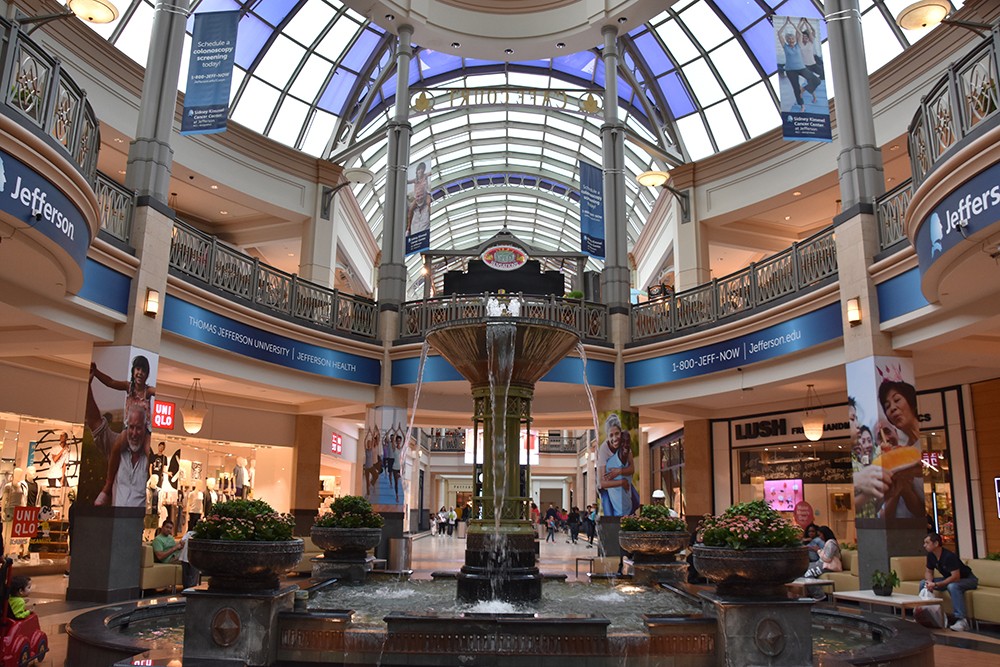
King of Prussia

First opened back in 1963, King of Prussia shopping mall in Montgomery, Pennsylvania still ranks as the largest center in the USA.

This giant retail precinct measures an astounding 2.9 million square feet with anchor tenants who are amongst the who’s who of modern retail.

Over 450 retailers call King of Prussia home, including Lord & Taylor, Dick’s Sporting Goods, Primark, Neiman Marcus, Nordstrom, Macy’s and Bloomingdale’s.

Over its 55-year history, King of Prussia has steadily grown from a modest open-air shopping centre to a mammoth shopping mall.

Adventura Mall

For 36 years Adventura Mall has been a retail drawcard for Florida. Located in Miami, it encompasses 2.7 million square feet and over 300 retailers, including anchor tenants like Nordstrom, Macy’s and Bloomingdales along with Apple, Adidas, Burberry, Cartier, Givenchy, Topshop, and Zara.

Like King of Prussia, Adventura has also experienced its fair share of changes over the years. It was home to the first Macy’s in Florida and was also once a major outlet for Sears.

In 2017, it opened a major expansion in the form of a three-story wing.

Del Amo Fashion Center

Del Amo Fashion Center in California has one of the lengthiest histories of any shopping centre in the US. This now mammoth precinct first started out as an open-air center that gradually morphed into one of the largest retail precincts in the US.

At its peak it reached 3 million square feet and was ranked the largest US shopping centre from 1981 to 1992.

These days it encompasses about 2.6 million square feet and boasts 255 retailers including anchor tenants Macy’s, Nordstrom, JCPenney and Sears.

South Coast Plaza

Top Shopping Malls in the US

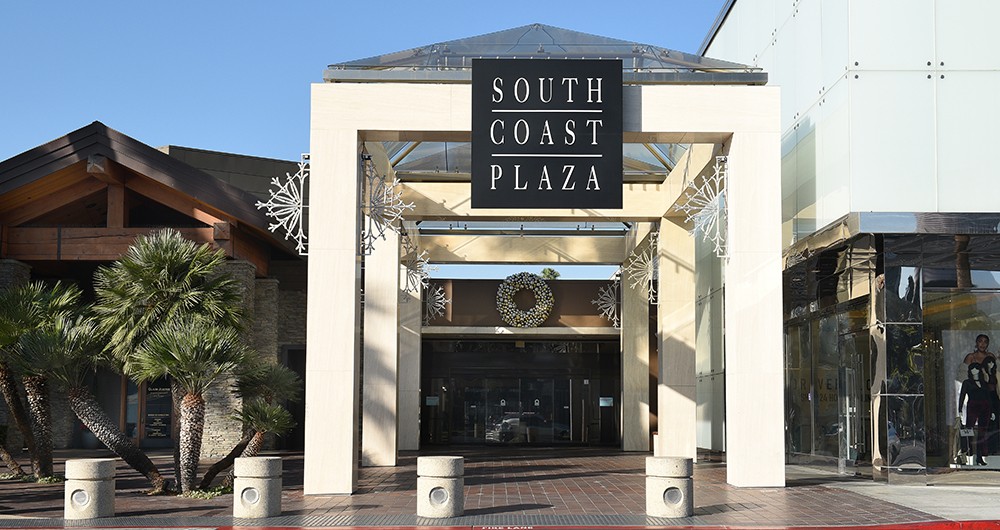
California is also home to the South Coast Plaza, a vast retail center that is touted as having America’s highest sales value of $1.5 billion annually.

Like King of Prussia shopping mall, South Coast Plaza opened in the 1960s as America’s urban sprawl shepherded in a new retail era, and over the years it too has undergone expansion.

The center is known for its distinctive architecture and due to early success, soon grew to include a new wing.

Now South Coast Plaza brings in 24 million visitors annually and features over 250 retailers, including Macy’s, Nordstrom, Saks Fifth Avenue, and Bloomingdale’s.

Mall of America

Although a latecomer to this retail list, the Mall of America is considered the largest in the USA in terms of floor area, spanning a whopping 4.8 million square feet in total.

First opened in 1992, it hosts all the mainstays of US retail including anchor tenants Nordstrom, Forever21, Marshall’s, Nickelodeon Universe, Lego World, and American Girl.

It also boasts an amusement park and Sea Life Aquarium, along with mini golf and cinemas. Last year it was also announced the Minnesota shopping mall would soon host a water park.

No decline here

The constant growth and evolution of all these major retail centers flies in the face of recent headlines that bricks and mortar is in the decline. Each offers a unique customer experience, with many having established themselves as not just a local shopping center, but as a destination and tourism drawcard where entertainment and retail meet.

Complete List of EAS Terms

The complete list of EAS terms explained

In loss prevention, Electronic Article Surveillance (EAS) is one of the most common and effective strategies to protect stock against theft. But with a wealth of terms, phrases and technical information, it also has the potential to be a little overwhelming.

This week we’re breaking down the language of EAS, with a guide to what those terms and phrases mean. Here’s a complete list of EAS terms explained.

Article Surveillance terms

Antenna

In EAS, the antenna is the component that “talks to” the tags and labels. Basically, an antenna sends out an electronic signal at regular intervals and the tag or label answers back. Antennas can be positioned in various places – overhead, in the door fame, in pedestals, under the floor and even in change rooms.

Pedestal

Positioned in the entryway to a shopfront, pedestals contain the antenna that monitors tags and labels. Depending on the width of the doorway and the type of EAS system being used, there may be one pedestal or two and sometimes more used to monitor tagged and labelled stock.

RF and AM

EAS operates at one of two frequencies – RF or AM. AM (Acousto Magnetic) systems operate at 58 KHz, which means a signal is sent out in pulses or bursts between 50 and 90 times a second while (RF) Radio Frequency or RF operates in a sweep at 8.2 MHz.

Hard Tags

Clothing Security Tags

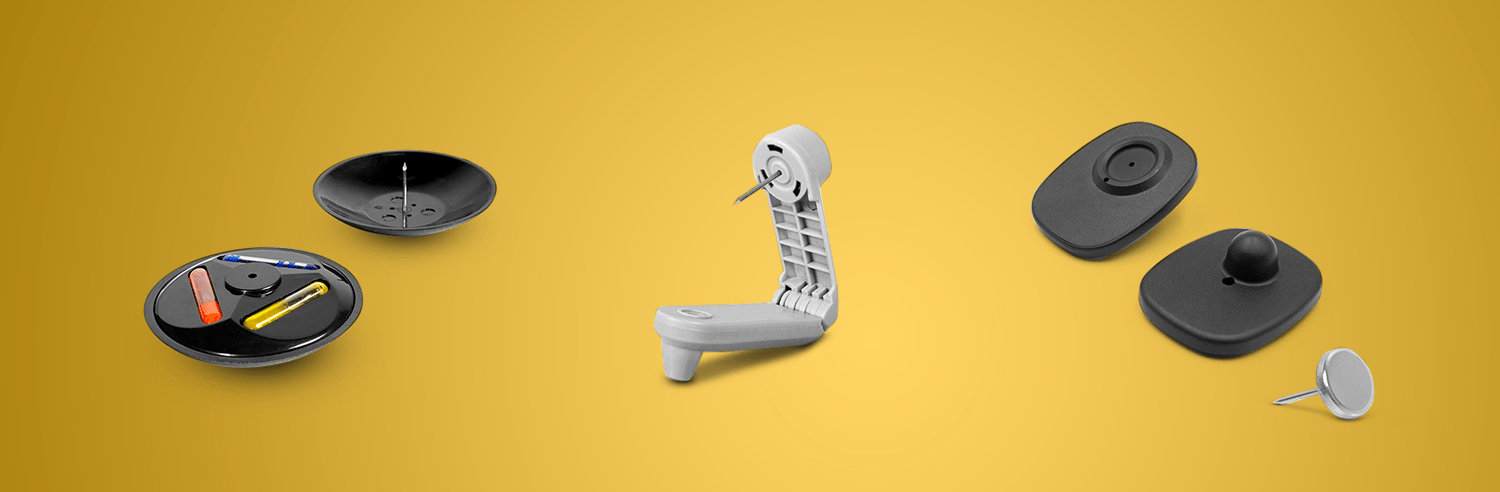
Hard tags or Security Tags are exactly as they sound, they are plastic tags that are affixed to clothing and other products. Within each tag is a transmitter that sends out a signal which is detected by an antenna in the store. Should communication between the tag and antenna be lost, an alarm sounds.

Hard tags come in a variety of shapes, such as pencil, square and clamshell. They also come in different strengths, and include a series of components: the tag, a pin which passes through the product into the tag, and a locking mechanism (either mechanical or magnetic).

Labels

Security labels work in the same way as hard tags, but are more commonly used at stores with a greater number of products or where attaching a hard tag simply isn’t feasible. They come in a variety of sizes. Labels can be affixed at the store or the point of manufacture.

Cable tag

cable tag is a hard tag that attaches to a product via a lanyard or cable. Suited to merchandise like jackets, shoes and handbags, the cable is made from materials that cannot be easily cut.

Alarming tag – Alarming tags are often an upgraded cable tag designed to offer multiple layers of security. Not only do they set of the EAS alarm when a shoplifter attempts to leave a store with an item, they also independently sound an alarm should someone try to tamper with the tag.

Detacher

The detacher is the device used to remove tags from products.

Deactivator

A deactivator is the device used to cancel the label’s signal so an item can leave a store without the alarm sounding.

Source tagging

Source tagging sees EAS tags and labels applied at the point of manufacture rather than in-store.

False alarm

An unintentional setting off of an EAS alarm where there is no intent to shoplift. False alarms may occur when an item fails to be deactivated at the checkout, a protected display item is placed too close to the EAS system, there are undetected security tags in the area, or if a system malfunctions.

Tag pollution

A condition caused when an active EAS label is taken from one retail location to a second retail location with a working EAS system, thereby causing an alarm to sound.

Pick Rate

The ratio of the number of times an EAS system detects an active EAS security label or tag versus the number of times it does not.

Pins

EAS

The pin is the component of hard tags that passes through a product and then locks into the tag. Pins come with different pin-head sizes. It’s generally noted, the larger the pin head size the harder it is to remove illegally as larger pins cannot be pulled through products without incurring damage. Ink pins can be added for increased deterrence.

Locking mechanism

All tags involve some sort of locking mechanism that secures the pinhead within the tag. The most common are mechanical locks and magnetic locks.

Strength

Magnetic locks come in a series of strengths:

  • Standard– Featuring a standard strength magnet, this option remains very popular with legacy systems but has the greatest potential to be circumvented by thieves.
  • SuperLock– Using a high-powered magnet often more than double the strength of standard magnets, tags of this grade provide increased resistance against illicit removal.
  • HyperLock– HyperLock features a combination of multiple high-powered magnets arranged into a single detacher body. HyperLock detachers are difficult for would-be criminals to manufacture, source and carry around.
  • Multipolar– Is the latest proprietary technology that requires sophisticated bi-directional magnets to release a tag. Multipolar tags cannot be released by any other magnet detacher no matter how powerful.

More information about general loss prevention terminology and common strategies is available here, or for assistance in sourcing the right security tags and labels for your store, contact our friendly Security Tags staff.

Retail Loss Prevention Explained

Retail Loss prevention terms explained

Loss prevention can quickly get confusing, with a wealth of industry-specific terms and acronyms used to describe the different technology, strategies and features. In a bid to assist, we’ve assembled the most common terms along with their meanings.

From EAS to ORC and LP, if you’ve ever wondered what all that retail loss prevention terminology means, here’s a quick list of loss prevention terms explained…

General terms

Loss prevention (LP)

Loss prevention is simply any initiative devised to minimize the loss of stock within a retail environment. It encompasses everything from preventing shoplifting right through to techniques used to count stock.

Retail shrink

Retail shrink or shrinkage is the loss of stock. It can be attributed to a host of factors including shoplifting, employee theft, employee fraud, administrative error, vendor fraud, or damage to stock in transit.

Shoplifter

A person who deliberately takes a product from a retail outlet without paying. Shoplifters generally have one of seven motives for stealing. These range from opportune theft to habitual stealing, stealing to fund addiction or stealing as an act of revenge.

Organized Retail Crime (ORC)

ORC is professional shoplifting, supply chain theft and other organized crime in retail environments perpetrated by crime rings. This type of theft is usually undertaken in groups and strategically targets items that can be easily sold at a high value.

Employee fraud

In retail, employee fraud usually involves cash register transactions, fraudulent refunds, gift certificates, false vendors and vendor collusion.

Analytics

Analytics is the electronic analysis of data collected about a retail environment. It includes information gathered at the Point of Sale such as sales data and returns, but also extends to traffic counting, inventory, sales transactions by staff members and more. Retail analytics are used by store owners and managers to monitor their stock and make more informed decisions within a retail environment.

Loss prevention strategy terms

Retail Loss Prevention Terms Explained

EAS

In loss prevention, EAS is one of the most common terms encountered. It stands for Electronic Article Surveillance and describes how tags and labels are affixed to products and then monitored electronically by an in-store antenna system.

EAS has been around since the 1960s. The premise behind it is simple; when a product exists the doors of a shop without the tag being removed or the label being deactivated, an alarm sounds and alerts staff on the floor.

Lockable displays

Whether it’s a locked draw, a secure glass cabinet or a freestanding display that retailers secure items to, lockable displays allow retailers to showcase items, but prevent thieves from taking them.

CCTV

Closed circuit television (CCTV) or video surveillance remains a common strategy to monitor the entire retail environment. If it’s monitored in real time, CCTV can help identify a theft occurring. If the surveillance is recorded, it can assist police investigating shoplifting and other retail crime.

LP Officer (security guard)

These are the loss prevention professionals tasked with preventing theft and catching perpetrators. Their role is partly as a deterrent and also as a real-time responder to theft.

Benefit denial

Benefit denial is a method used to negatively impact a product that someone attempts to steal. The most common example is ink dye tags. When a thief attempts to remove them without the correct detacher, ink releases and renders the item unusable.

Stop lock

A lock that is placed on the end of a wire hook, meaning consumers can only access the product with the assistance of a staff member.

Smart locks

A lock used on retail cabinets or drawers that is opened via an electronic key. The key can be coded for use by different staff members or for use in specific areas.

If you have any further questions about the right loss prevention strategies to protect your store, our friendly Security Tags staff are available to assist, and can be contacted here. Meanwhile stay tuned for an upcoming blog that will take a deep dive into all the terminology involved in EAS.

Liquor Security Tags

Protecting liquor from theft

The brazen theft of a $4000 bottle of cognac from a Massachusetts liquor store last week has highlighted just how prevalent alcohol shoplifting is, with wine and spirits remaining the most commonly stolen products in the food and beverage sector.

So, how do retailers go about protecting this readily available, easily concealed item?

Here’s an insight into liquor security tags and how they work to prevent shoplifting when it comes to wine and spirits.

The liquor dilemma

According to the most recent Global Retail Theft Barometer, liquor is the most commonly stolen item in the food and beverage sector. It ranks ahead of baby formula, meat, cheese and coffee.

Meanwhile, the National Retail Federation also notes high-end liquor is amongst the top 10 targets for shoplifters across all verticals. The reason it’s so popular is that it ticks a series of shoplifting boxes.

Alcohol is often readily available, is rarely locked up unless it’s very expensive, is easy to conceal and commands a high resale value. And anecdotal evidence suggests different types of thieves target it for different reasons.

Opportune pilfering

Some shoplifters steal liquor simply because the opportunity arises. This category of opportune thieves incorporates teens who steal alcohol almost as a rite of passage and people who may already be under the influence, and harness their decreased inhibitions to have a further drink with a five-finger discount.

These types of thieves usually go after lower value items that are easy to access.

Strategic shoplifting

Other thieves are more strategic in their product selection, targeting high-value liquor that can be resold at a greater price. These sees liquor amongst the prime targets for organized retail crime.

But regardless of the reason or strategy behind it, alcohol theft costs retailers a significant sum, contributing to an estimated $46.8 billion in total across all verticals shrink each year, according to the latest National Retail Federation survey.

Liquor Security Tags

The cognac conundrum

News website East Texas Matters recently reported on February 26 a man entered a liquor store in Seekonk, Massachusetts then set about brazenly stealing a $4000 bottle of cognac that was kept in a locked case, near the counter, in full view of staff.

Video footage reveals he possibly picked the lock, allegedly took the bottle of Louis the 13th Remy Martin and moved out of view to conceal it in his clothing before paying for other items and leaving the store.

And it’s far from the only incident making the news. So what options do retailers have?

Liquor security tags

Designed specifically to protect wines and spirits, liquor security tags are amongst the latest innovations in Electronic Article Surveillance.

The caps are designed to fit over the bottle top, can only be removed at the Point of Sale and ensure an alarm sounds if a thief tries to steal the item.

They also prevent alcohol from being consumed in the store, are available to suit both RF and AM EAS systems and offer a universal fit to suit varying bottle neck shapes and sizes.

As an added benefit, the caps are available in bulk, are reusable and easy for store assistants to remove and attach. They also offer an affordable way to protect products while still allowing the consumer to access, touch, feel and examine them.

Locked cabinets

When it comes to top-shelf liquor many retailers opt to secure their products behind glass, and this has both benefits and drawbacks.

Glass cabinets allow the consumer to see the product but not touch it. It enables the staff to keep the items under their control but can cost time when it comes to access. Meanwhile, as noted in the instance above the locks need to be impervious to picking.

CCTV

CCTV and video surveillance are excellent loss prevention strategies for monitoring an entire store, and can be a tool that deters thieves from committing an act of theft

However, CCTV often detects a crime and identifies a criminal after the incidence has occurred, leaving the matter in the hands of police rather than avoiding a theft.

You can learn more about liquor bottle security tags here.