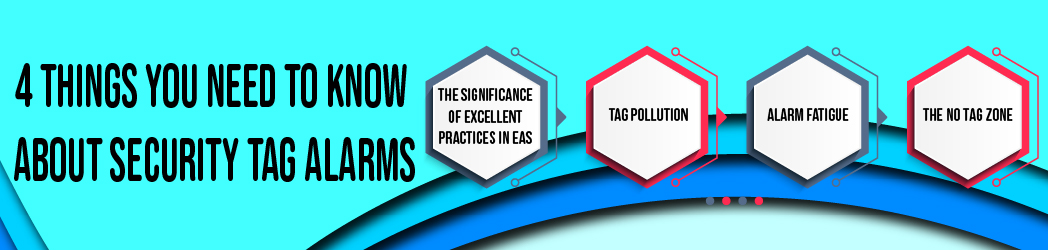
4 THINGS YOU NEED TO KNOW ABOUT SECURITY TAG ALARMS

The fact that electronic article surveillance (EAS) notifies your workers to a suspected theft is by far the most effective aspect. 

 This helps retail employees to focus on the task at hand rather than being distracted by looking for shoplifters on the shop floor. 

There are, however, a few pointers to guarantee that alarms only sound when they should and that your employees understand what each alert implies. 

 So here are four things you should be aware of when it comes to security tag alarms… 

The significance of excellent practices in EAS 

As a retail loss prevention tool, EAS is highly popular and effective. When security tags and/or security labels are applied on items, the system detects them and, when they approach a zone near the shop exit, an alarm sounds to inform employees that a theft may be taking place. 

The system, however, is only as good as the regulations, processes, and education that it is surrounded by. 

That means your workers should be instructed on how EAS works and how to respond appropriately to a warning and its implications. 

Tag Pollution 

When another store fails to properly deactivate or remove a tag, tag pollution arises. Your EAS system may trigger when a consumer carrying that item enters your retail area. 

Most EAS antennas now incorporate a lighting system that shows if an alert is being triggered by an incoming or outgoing tag. 

The meaning of the illumination on the EAS antenna should be explained to the staff. 

When it’s likely that a tag from another business has triggered your alarm, they should be taught measures to follow, such as verifying the shopper’s bag. 

Alarm Fatigue  

It implies something when an EAS antenna raises an alarm. However, some establishments fail to follow EAS best practices, and the alert rings so frequently that employees become oblivious to its possible implications. 

This is generally due to one of four factors: 

Pollution should be labelled. 

Tags in the forbidden zone 

Failure to detach tags or deactivate labels appropriately. 

Inadequate EAS system maintenance and incorrect inspections. 

So, what exactly do each of these terms imply? 

The No Tag Zone 

A no-tag zone is defined as the area between and surrounding the EAS antenna. This is an area where branded or labelled items, as well as decorations with a high foil content, should be avoided. 

If there are any marked or labelled things in this vicinity, the EAS antenna will most likely sound. 

The EAS system is usually within six feet of the “No Tag” zone. 

As a quick check, extend your arms out like you’re performing a star leap and look around each pedestal for any security tags within reach or just out of reach. 

Alarms are produced by a tag in the area of the antenna in over 90% of documented occurrences of false alerting. 

Failure To Properly Detach Tags 

Security tags must be removed at the point of sale, while labels must be disabled, to prevent the EAS system from raising an alert when an item left the store. 

Staff should be thoroughly instructed on how to perform this efficiently, as well as provided with the necessary equipment. 

Deactivators can be included within the scanning area of the checkout so that the label is deactivated at the same time as the barcode is scanned during a sales transaction, whereas detachers are normally tethered to the POS. 

Daily Checks  

Your EAS system should be examined regularly and repaired as needed because it is a valuable piece of equipment that is meant to safeguard a merchant from loss. 

Your manufacturer’s recommendations are likely to specify exactly what checks and services are required, but at the very least, the system should be examined each morning before the store opens to verify it is powered up and operational. 

Staff should also make sure the label deactivator is turned on at the same time. 

Additional resources:  

https://www.securitytags.com/the-different-types-of-security-tags/ 

https://www.ineoproducts.com/blogs/industry-banter/tags-vs-labels-which-one-should-you-use 

https://www.ineoproducts.com/blogs/industry-banter/everything-you-need-to-know-about-security-labels 

 

COVID, retail, retail security, loss prevention, EAS

SIX WAYS COVID-19 MADE RETAILERS THINK OUTSIDE THE BOX

COVID-19 brought hardship to the retail space. As lockdowns and unemployment rampaged on, going out to spend money was just not in the picture for the majority of people. Luckily a few advancements along with the drive to reach customers, retail stores were able to bounce back. 

 Expanding your offering 

One thing a lot of retail spaces did was expand the product line that they offered. Stores like Target, which already had a large selection of items, to begin with, reached even further by supplying essential goods in multiple ways, which is something we will touch on later in this post. 

Get Online 

Prior to COVID-19, people started to see the power of giving the customer the option to buy products online. Companies looked up to for things like this would be Amazon, Walmart, and Target, which played a role in growth in what we touched on a little bit ago. With people spending more time indoors and not wanting to go out and shop, why not bring the store right to their fingertips. Online shopping will only get more and more popular as time goes on and technology grows around it. The convenience factor will always be there and it gives people the time that would have been spent shopping, to pursue other things on the weekly to-do list. 

Be Informative 

This can be done in a number of ways. Using clothing retailers as the primary example, have ways to show off your product in more ways than just on a single model. Implementing things like size guides, models in all shapes and sizes, and even ways to mix and match multiple products. Lululemon is the best example here to give as not only did online shopping become easier for their shoppers, but with this also came an all-time high in sales and a huge increase in company stock.

Communication is key 

As seen time and time again during the height of the pandemic, being open and communicating with your customers makes things easier for everyone. Use the platforms all around you in things like social media and email flyers to get the word out. People want to know what’s going on, so coming out with plans for your retail space and products gives people the insight they have been looking for.  

Reach out 

Hitting on the point above, using things like social media platforms to start a dialogue with your customers. Be engaging, open, and informative when talking to customers, doing so will not only lead to more returning shoppers but by word of mouth, a great lump sum of newer customers. Ensuring you have a loyal customer base is one of the greatest building blocks used to example your retail space. 

 What about the In-Store Experience 

 Let’s not forget, even with all the rambling on about all the advancements made through online shopping, what about the people, especially as time goes on and things get closer to what we would call “normal”, that still want to go to an actual store? Let’s hit on a few points that have been updated over the last couple of years. Since consumers have the “get in and out quickly” mentality, retailers have reconfigured their stores to facilitate faster, more streamlined shopping trips. COVID-19 has also accelerated the need for retailers to shift to more experiential showrooms instead of traditional stores. A store that hits on both these points very well would be IKEA.

https://business.fiu.edu/graduate/insights/why-retailers-will-bounce-back-to-a-new-reality-after-the-pandemic.cfm 


https://www.thinkmax.com/en/insights/why-enhancing-the-post-covid-in-store-experience-should-be-top-of-mind-for-every-retailer/ 


https://www.retaildive.com/news/5-retailers-winning-despite-the-pandemic/586602/ 

Google shows faith in physical retail

https://www.cnbc.com/2020/12/15/lululemon-ceo-expects-digital-growth-momentum-to-continue-post-pandemic.html 


https://www.forbes.com/sites/rohitarora/2020/06/30/which-companies-did-well-during-the-coronavirus-pandemic/?sh=669a34287409 

lanyard tag, cable tag, strap tag security tag rf tag

Let’s talk lanyard, cable and strap tags

In the world of electronic article surveillance, hard tags have evolved to protect a wide variety of products ranging from clothing to liquor, eyewear and fashion accessories.

And one way they have improved to accommodate these different products is through the addition of cables, lanyards or straps.

Cables, lanyards and straps allow hard tags to be affixed to products like footwear, handbags and more, offering a simple yet secure solution where the pinhead of the tag is not required to pass through the product.

So let’s talk lanyard, cable, and strap tags, how they work and when they are used to best effect…

What is a lanyard or cable tag?

Cable and lanyard tags are available in a variety of styles, but the principle is always the same; rather than having the tag fix directly to the item and the tag pinhead pass through the product, in this instance the security tag is affixed to the item using a cable, lanyard or strap.

These lanyards and cables are available in different strengths featuring materials which are resistant to being cut such as steel or heavy-duty plastics.

Some lanyards have pins on the end which then lock into the tag, some have secure loops which fit onto the tag, while some feature adjustable straps that affix to the product like a zip-tie and have the tag built-in.

The benefit of these types of tag options is that they allow retailers the ability to affix security tags to a wide range of products while catering to items of different sizes, shapes and materials.

So what type of products do we mean?

Products suited to lanyard and cable tags

Lanyard and cable tags work with a wide variety of products but are particularly suited to those tricky items where it’s not appropriate for the pinhead of a hard to pass through the product.

That means they can be used on:

  • Handbags
  • Sports shoes
  • Sporting goods
  • Luggage
  • Hardware tools

Let’s look at some examples…

Handbags

Often made of premium materials like leather, handbags frequently feature in the most stolen items’ list for both department stores and designer brands.

High in value, and easy to re-sell on the black market, they are a target for both organized retail crime (ORC) and individual shoplifters.

To combat this, lanyards are often used to affix a hard tag to the handbag, with the lanyard able to pass through either the zip-puller or the strap of the bag.

Sports shoes

Believe it or not footwear ranks as the most commonly stolen item in the apparel and fashion accessories vertical, according to the most recent Global Retail Theft Barometer.

Lanyards and tags offer a means to protect these items in an innovative way, particularly when it comes to sports shoes. In this instance, the lanyard or cable is inserted through a lace hole in the shoe, and then locks onto an EAS hard tag.

Luggage

Like handbags, luggage is protected with tags and lanyards by looping the lanyard through the luggage handle or through the eye of the zip-puller.

Hardware tools

High in value and sought after by thieves, hardware tools often require an innovative approach to theft prevention. Again, this is where an option like the strap tag is ideal. It firmly affixes to power tools or hand tools, and allows the item to be monitored by EAS at a product-based level.

The final word

These are just some of the ways that lanyards, cables and straps are used in conjunction with EAS security tags to prevent the theft of tricky items.

Of course, they can also be applied to a whole host of other products when standard clothing tags simply aren’t suited to the task.


You can see our full range of lanyard, cable and strap tag options here.